Posts
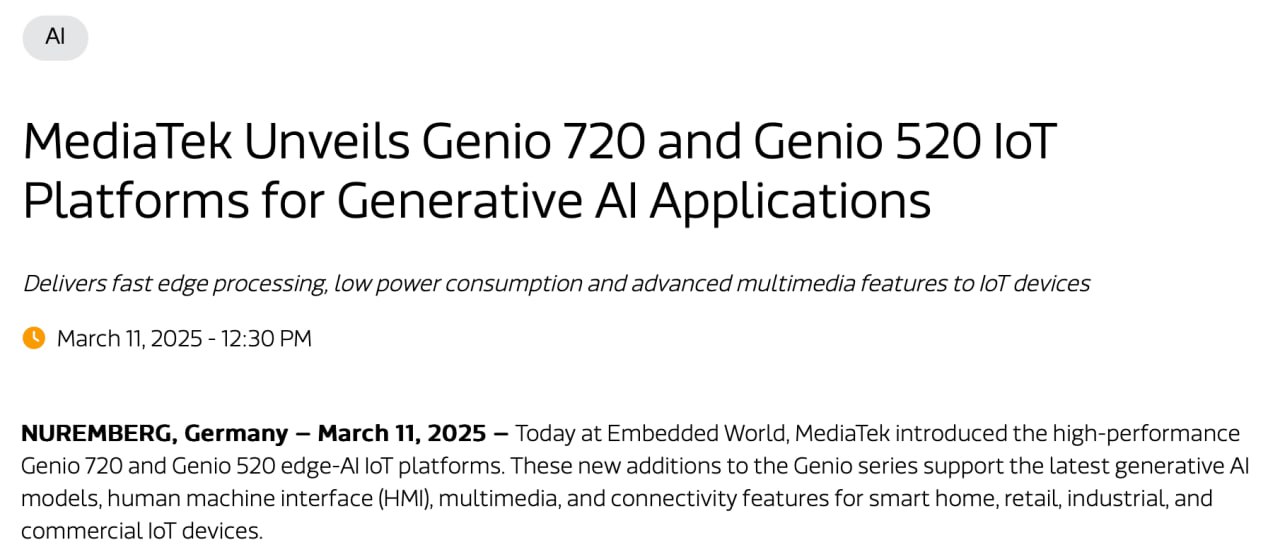
The Taiwanese company MediaTek announced the release of its latest Genio 720 and Genio 52…
March 30, 2025 at 4:54 PM•Max Knyazev is typing…Telegram mirror
Taiwanese company
MediaTek
announced the release of its latest chipsets
Genio 720 and Genio 520
, which are designed to radically change the approach to creating IoT devices with support for generative AI (
yes, yes, conference
Embedded World 2025
I was in Nuremberg almost three weeks ago, and as always I was on time
). At first glance, everything is standard: high performance, energy efficiency and impressive multimedia capabilities. But let's dig deeper
🫡
The main feature of the new platforms is the built-in eighth generation neural processor (NPU), which is capable of providing up to 10 TOPS of computing power. Why so much? But
👇
The Genio 720 and 520 are built on a 6-nanometer process technology and eight-core processors with two powerful Arm Cortex-A78 cores and six energy-efficient Cortex-A55 cores. With such hardware, devices will not only be able to perform artificial intelligence tasks, but also simultaneously support multiple high-resolution displays ( one ultra-wide screen in 4K/5K or two 2.5K displays ), and also process streaming 4K video with virtually no delays. Just think, they offer built-in support for up to six cameras with FullHD resolution and 30 frames per second
⚡
Separately, it is worth noting the work with memory. The platforms support up to 16GB of high-speed LPDDR5 memory, which is critical for running complex multilingual models and multimodal generative AI applications efficiently. By the way, MediaTek has already integrated support for frameworks from NVIDIA TAO and other leading AI developers, which significantly simplifies the work of developers
Another nice feature is flexibility and compatibility. Android, Yocto Linux and Ubuntu operating systems are supported. Add here support for Wi-Fi 6/6E and the ability to expand to Wi-Fi 7 and 5G RedCap via external modules - and we get an almost universal solution
😅
Of course, a logical question arises ( at least for me ): what about security? IoT devices have long been a target for attacks and require reliable data protection and privacy ( that we all know and understand perfectly well ). And this is where MediaTek assures that all AI functionality will be processed directly on the device. In theory this is lower Reduces the risk of leaking confidential information through the cloud or remote servers. But the community's reaction was still divided ( oh well, how unexpected and unpleasant )
😳
Some experts are already calling Genio 720 and 520 a real breakthrough that will change the IoT and AI market, while others are more reserved about the statements, believing that the practical effectiveness of the platforms still requires serious tests. But it is clear that MediaTek is challenging its competitors and opening up new opportunities for developers of smart homes, retail and the industrial Internet of things
My opinion - we'll wait and see. It’s difficult to say anything specifically here. Due to my extremely skeptical nature, I cannot and do not want to write any laudatory reviews. It is too early to say that this is a breakthrough. We need to look at further implementation. And when the technology fully shows itself, then it will be clear whether the game is worth the candle. I can say one thing - the news is interesting and sounds promising
👍
Share your opinion in the comments. Interesting to listen to more accurately read )
🤔
#internet_things
Open original post on TelegramThe main feature of the new platforms is the built-in eighth generation neural processor (NPU), which is capable of providing up to 10 TOPS of computing power. Why so much? But
Now devices based on these chips will be able to run heavyweight generative AI models directly on the device itself, without turning to the cloud. Neural networks like Llama, Gemini, Phi or DeepSeek used to require serious server resources. Now they can be deployed on compact and energy-efficient hardware
The Genio 720 and 520 are built on a 6-nanometer process technology and eight-core processors with two powerful Arm Cortex-A78 cores and six energy-efficient Cortex-A55 cores. With such hardware, devices will not only be able to perform artificial intelligence tasks, but also simultaneously support multiple high-resolution displays ( one ultra-wide screen in 4K/5K or two 2.5K displays ), and also process streaming 4K video with virtually no delays. Just think, they offer built-in support for up to six cameras with FullHD resolution and 30 frames per second
Separately, it is worth noting the work with memory. The platforms support up to 16GB of high-speed LPDDR5 memory, which is critical for running complex multilingual models and multimodal generative AI applications efficiently. By the way, MediaTek has already integrated support for frameworks from NVIDIA TAO and other leading AI developers, which significantly simplifies the work of developers
Another nice feature is flexibility and compatibility. Android, Yocto Linux and Ubuntu operating systems are supported. Add here support for Wi-Fi 6/6E and the ability to expand to Wi-Fi 7 and 5G RedCap via external modules - and we get an almost universal solution
Of course, a logical question arises ( at least for me ): what about security? IoT devices have long been a target for attacks and require reliable data protection and privacy ( that we all know and understand perfectly well ). And this is where MediaTek assures that all AI functionality will be processed directly on the device. In theory this is lower Reduces the risk of leaking confidential information through the cloud or remote servers. But the community's reaction was still divided ( oh well, how unexpected and unpleasant )
Some experts are already calling Genio 720 and 520 a real breakthrough that will change the IoT and AI market, while others are more reserved about the statements, believing that the practical effectiveness of the platforms still requires serious tests. But it is clear that MediaTek is challenging its competitors and opening up new opportunities for developers of smart homes, retail and the industrial Internet of things
My opinion - we'll wait and see. It’s difficult to say anything specifically here. Due to my extremely skeptical nature, I cannot and do not want to write any laudatory reviews. It is too early to say that this is a breakthrough. We need to look at further implementation. And when the technology fully shows itself, then it will be clear whether the game is worth the candle. I can say one thing - the news is interesting and sounds promising
Share your opinion in the comments. Interesting to listen to more accurately read )
#internet_things
Discussion
Comments
Comments are available only to confirmed email subscribers. No separate registration or password is required: a magic link opens a comment session
Join the discussion
Enter the same email that you already used for your site subscription. We will send you a magic link to open comments on this device
There are no approved comments here yet