Posts
Hello to all Ayotovites of this channel 👋 In one of my posts I promised to talk about “du…
April 1, 2025 at 3:11 PM•Max Knyazev is typing…Telegram mirror
Hello to all Ayotovites of this channel
👋
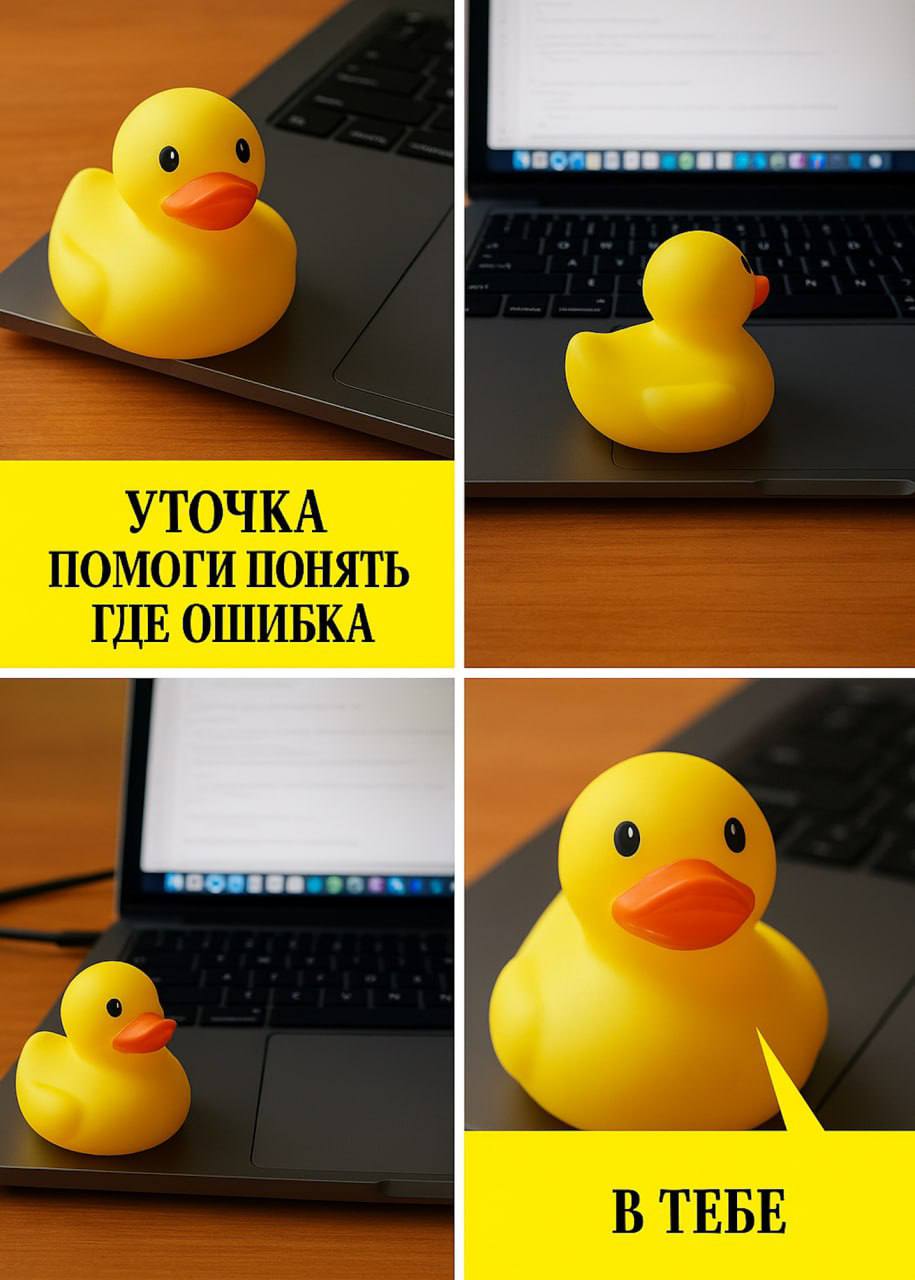
I'm here in one of posts promised to tell about the "duck" ( in the original it is called rubber duck debugging ). I feel like today is a great day for this. A little history
🤓
In general, the expression "tell that to the rubber ducky" came from a book "The Pragmatic Programmer" , published in 1999 Andrew Hunt and David Thomas. The authors described a simple but incredibly effective way to debug code. You just need to explain your code and the logic of the program to a small inanimate object. Sounds a little strange, I agree. But let's figure out why it works.
Imagine this situation: you spend hours working on some bug, looking through the code line by line, but you just can’t figure out where the error is. This is where the moment of truth comes. You take a rubber ducky ( although any object can act as a duck - a mug, a cactus or even a photo of a cat ) and start explaining to her out loud how your code works. An important condition is to speak out loud and in as much detail as possible, step by step, as if you were really explaining your code to someone
(
Nowhere is it stated that this cannot be an unfortunate intern whom you caught and are keeping at your workplace
)
🤝
It is this process that helps your brain restructure and look at the problem from a new perspective. The point is that when we explain something to another, even if it is a silent duck, we begin to think more clearly and more structuredly. Suddenly, in the process of your story, you suddenly stop at some line of code and understand: “And this is where I was wrong!”
🧐
Why exactly the duck? This is part joke, part marketing. At that time, programmers often had funny toys on their desks, which relieved the tension a little and helped distract them. So the rubber duck, a simple and cheerful toy, became a symbol of that very moment of epiphany
By the way, this method has long become part of the professional culture of developers and even found its place in the offices of many large IT companies, where newcomers are sometimes directly given a duck as a kind of talisman and assistant in the first days of work
(
I repeat, an intern can act as a duck
)
🦆
If you still don't have a duck on your table ( or its equivalent ), it's time to correct this omission tion. I have such a duck too ( Our classmates gave us gifts on February 23, when I was still receiving my higher education )
Share your ducks or any other cute things that you have on your desktop in the comments.
😎
Open original post on TelegramI'm here in one of posts promised to tell about the "duck" ( in the original it is called rubber duck debugging ). I feel like today is a great day for this. A little history
In general, the expression "tell that to the rubber ducky" came from a book "The Pragmatic Programmer" , published in 1999 Andrew Hunt and David Thomas. The authors described a simple but incredibly effective way to debug code. You just need to explain your code and the logic of the program to a small inanimate object. Sounds a little strange, I agree. But let's figure out why it works.
Imagine this situation: you spend hours working on some bug, looking through the code line by line, but you just can’t figure out where the error is. This is where the moment of truth comes. You take a rubber ducky ( although any object can act as a duck - a mug, a cactus or even a photo of a cat ) and start explaining to her out loud how your code works. An important condition is to speak out loud and in as much detail as possible, step by step, as if you were really explaining your code to someone
It is this process that helps your brain restructure and look at the problem from a new perspective. The point is that when we explain something to another, even if it is a silent duck, we begin to think more clearly and more structuredly. Suddenly, in the process of your story, you suddenly stop at some line of code and understand: “And this is where I was wrong!”
Why exactly the duck? This is part joke, part marketing. At that time, programmers often had funny toys on their desks, which relieved the tension a little and helped distract them. So the rubber duck, a simple and cheerful toy, became a symbol of that very moment of epiphany
By the way, this method has long become part of the professional culture of developers and even found its place in the offices of many large IT companies, where newcomers are sometimes directly given a duck as a kind of talisman and assistant in the first days of work
If you still don't have a duck on your table ( or its equivalent ), it's time to correct this omission tion. I have such a duck too ( Our classmates gave us gifts on February 23, when I was still receiving my higher education )
Share your ducks or any other cute things that you have on your desktop in the comments.
Discussion
Comments
Comments are available only to confirmed email subscribers. No separate registration or password is required: a magic link opens a comment session
Join the discussion
Enter the same email that you already used for your site subscription. We will send you a magic link to open comments on this device
There are no approved comments here yet